Can You Get Pregnant During Perimenopause?
Quick answer: Yes — you can get pregnant during perimenopause, and the evidence is more encouraging than most articles suggest. Even in late perimenopause, when the majority of cycles no longer release an egg, roughly one in four cycles longer than 60 days is still ovulatory. Ovulation simply happens much later than you expect — around cycle day 27 — which is why so many women conclude they have stopped ovulating when they have not. Your reproductive stage predicts this better than your age does, and a low AMH result does not close the door on natural conception. Rejuvenating Fertility Center treats women through perimenopause and beyond, with no age cutoff and no weight cutoff.
What Perimenopause Is — and Why It Matters for Fertility
You have been trying for a year. Your cycles are all over the place — 24 days, then 51, then nothing for two months. You are not sure you are still ovulating. Someone told you to just use birth control, as though the only reason you would ask this question is to avoid an accident.
That is the wrong assumption, and it is the reason most articles on perimenopause pregnancy are useless to you. They are written for women trying not to conceive. This one is written for you.
Perimenopause is the transition leading up to your final period. It is staged clinically using the Stages of Reproductive Aging Workshop (STRAW) system, which sorts women by cycle pattern rather than by birthday. Early transition means your cycle length has started varying by more than seven days. Late transition means you have skipped 60 days or more. Menopause itself is only confirmed after 12 consecutive months without a period — and until that point, pregnancy during perimenopause remains biologically possible.
The mechanism is straightforward. Your remaining follicles respond less predictably to FSH, so recruitment becomes erratic rather than absent. Cycles alternate between ovulatory and anovulatory. Estrogen can swing high, not just low. Progesterone in the second half of the cycle drops even when ovulation does occur, which affects the uterine lining and implantation — and that is treatable.
Esta página es para ti si:
You are 40 to 50 with irregular or skipped cycles and you want to conceive
You have been told your AMH is "too low to bother" with your own eggs
You have been declined by a clinic because of your age, your FSH, or your BMI
You are on hormone therapy and were never told it does not work as contraception
You are under 40 with early perimenopausal symptoms and want answers now
If you are under 40 with an AMH above 1.0 and a straightforward history, our sister clinic Aurea Fertility is built for you. If you are over 40, have low reserve, or have already been turned away somewhere else, you are in the right place.
Why Women Ask This Question at RFC
They were handed a bucket instead of a number
National statistics report women over 42 as a single category. That tells you nothing about a 43-year-old with three antral follicles versus a 47-year-old with eight. RFC stages you individually — reproductive stage, antral follicle count, hormone panel, uterine assessment — because the group average was never about you. Our three types of IVF exist precisely so protocol matches profile.
Their cycles stopped being readable
Ovulation predictor kits are calibrated for a 28-day cycle. In late perimenopause they routinely miss the surge entirely — not because it did not happen, but because it happened on day 30 and the test strips ran out on day 20. Confirmed ovulation changes the entire conversation.
They were told a lab value was a verdict
Low AMH gets treated as a prognosis. It is not one — for natural conception, the research says something quite different, which we cover below. If your number came back low, our guide on how to boost AMH level goes deeper.
Another clinic said no
Conventional IVF centers protect their reported success rates by declining difficult patients. RFC was founded on the opposite premise. There is no age cutoff and no weight cutoff here, and women in perimenopause are among the patients we see most.
How Ovulation Actually Works in Perimenopause
Here is what the cycle looks like as the transition progresses:
Follicle recruitment turns inconsistent. FSH rises to push the remaining follicles harder. Some cycles a follicle matures; some cycles none does.
The follicular phase stretches. The dominant follicle takes longer to reach maturity, so ovulation drifts later and later in the cycle.
The LH surge still happens — off schedule. It is not absent in ovulatory cycles. It has moved.
Luteal progesterone declines. Even in cycles that ovulate, corpus luteum output falls, which can compromise the lining an embryo needs.
Long cycles are not automatically empty cycles. A 70-day gap does not mean nothing happened.
Two of those points are directly actionable, and both are addressed at RFC — extended-window ovulation confirmation, and luteal support. Neither requires IVF to start.
What the Research Shows — Perimenopause Pregnancy Outcomes
The best available data on ovulation across the transition comes from daily urinary hormone monitoring in 108 women followed over five years (O'Connor et al., Menopause, 2009). Two findings matter enormously and are almost never reported:
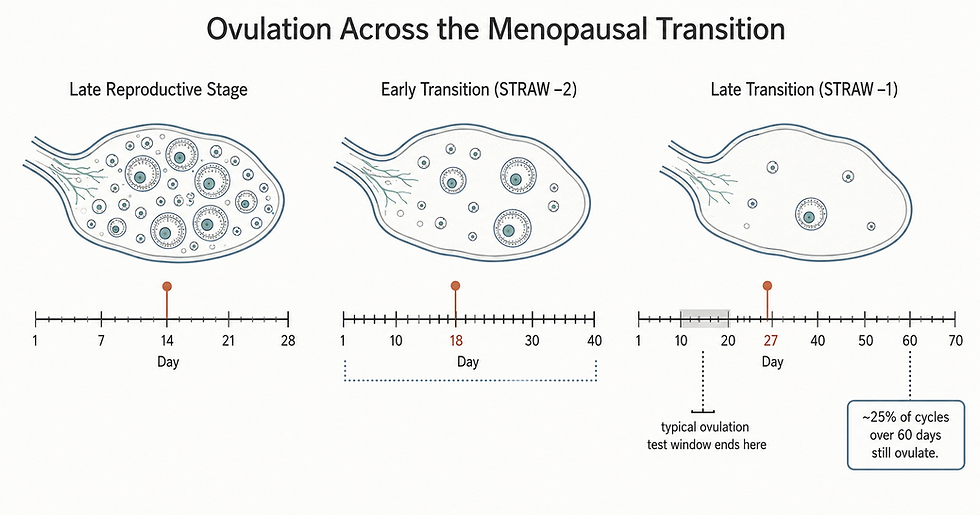
First, reproductive stage predicted anovulation better than chronological age did. Your cycle pattern tells us more than your birth year. Second, although more than 60% of late-transition cycles were anovulatory, about one quarter of cycles longer than 60 days still ovulated, and the authors concluded that conception exposure in late perimenopause is far from negligible. Average ovulation in that group landed on cycle day 27.
A separate STRAW-staged cohort found the same pattern in a different population (Hale et al., Journal of Clinical Endocrinology & Metabolism, 2007).
Reproductive stage | Cycle pattern | Anovulatory cycles | What it means for you |
Late reproductive | Regular, subtle shortening | 0 of 16 cycles (Hale) | Ovulating nearly every cycle; timing is standard |
Early transition (STRAW −2) | Length varies >7 days | 1 of 16 cycles (Hale) | Most cycles still ovulate; widen your testing window |
Late transition (STRAW −1) | Skips of 60+ days | >60% (O'Connor); 9 of 23 (Hale) | ~25% of long cycles still ovulate, near day 27 |
What your AMH and FSH actually predict
This is the single most important thing on this page. In a prospective study of 750 women aged 30 to 44 with no history of infertility, Steiner et al. (JAMA, 2017) found that women with low AMH below 0.7 ng/mL had an 84% cumulative probability of conceiving within 12 cycles, compared with 75% in women with normal AMH. Women with high FSH above 10 mIU/mL reached 82%, against 75% with normal FSH. Neither difference was statistically significant. Inhibin B showed no association either.
A larger cohort of 3,150 women (Fertility and Sterility, 2024) found a modest reduction with low AMH but still recorded an 11.2% per-cycle probability of natural conception in the low-AMH group, against 14.3% with normal levels.
The biology is simple once stated. AMH and FSH measure how many follicles you have left, which is what predicts your response to stimulation drugs. Natural conception needs one competent egg, not a large cohort. Those are different questions, and one lab value cannot answer both.
What the IVF data says about women 43 to 46
National US registry data covering 24,650 women over 42 reported cumulative live birth rates with their own eggs of 9.7% at 43, 8.6% at 44, 5.0% at 45, and 3.6% at 46 (Seifer et al., Reproductive Biology and Endocrinology, 2023). A European single-center series of 833 women aged 43 and older found a first-cycle live birth rate of 4.8% at 43 (Fernandez et al., Reproductive BioMedicine Online, 2021).
Read those numbers correctly. They are averages produced by conventional clinics running conventional protocols on unselected patients. And the same registry analysis found no association between day-3 FSH, AMH, and live birth in women over 42 — meaning the labs used to decline you at this age do not predict your outcome.
The genuinely useful finding is about timing: cumulative rates plateaued by the fifth cycle at ages 43 to 44, and by the third cycle at 45 to 46. That is a decision point, not a stop sign. It tells you when to change the approach rather than repeat it — which is exactly the conversation RFC has with patients, and exactly the conversation a volume clinic does not have time for.
Where regenerative options currently stand
Dr. Zaher Merhi was the first physician in the United States to develop ovarian PRP protocols for diminished ovarian reserve, and RFC published the first reported live births in women over 45 using their own eggs following adipose-derived PRP — work covered twice by Forbes. [NO URL AVAILABLE — verify RFC publication link before publishing]
Here is the honest state of the wider literature. Across 353 women treated with intraovarian PRP, poor responders showed oocyte maturation rise from 65.8% to 80.8% and fertilization from 61.6% to 75.8%, while women with primary ovarian insufficiency saw antral follicle gains without improved IVF outcomes (Molinaro et al., Fertility and Sterility, 2025). A cohort of 311 women with POI recorded 7.4% spontaneous pregnancies after PRP (Cakiroglu et al., Aging, 2020), and a cohort of 510 poor responders averaging 40.3 years reported a 20.5% pregnancy rate and 12.9% live birth rate (Aging, 2022). A pooled analysis of seven randomized trials totaling 422 women did not find a significant pregnancy-rate improvement over controls (Fang et al., Frontiers in Endocrinology, 2026).
So: consistent gains in reserve markers and egg maturation, encouraging cohort outcomes, randomized evidence still maturing. RFC offers these as physician-supervised options — Super Ovarian Rejuvenation, bone marrow stem cell-enriched PRP, and uterine rejuvenation — selected when your labs and history justify them, and explained to you with exactly this level of candor.
The Question No One Answers: Why Are Your Ovulation Tests Negative?
Every article on this keyword tells you pregnancy is possible in perimenopause. None of them tells you why your own tests keep saying otherwise.
The answer sits in the O'Connor data. Mean ovulation in late perimenopause occurred on cycle day 27. A standard drugstore ovulation kit contains enough strips to test roughly days 10 through 20. If you ovulate on day 27, you will test negative every single month while ovulating regularly — and reasonably conclude you have stopped.
There is a second trap. Baseline FSH rises across the transition, and some LH strips cross-react with FSH, producing faint lines that never resolve into a clear surge. You read that as "no ovulation." It is often "wrong test for this stage of life."
What actually works instead:
Test through the whole cycle, not a window. Start on day 10 and continue until bleeding begins — day 45, day 60, however long it takes.
Confirm on the back end, not the front. A mid-luteal progesterone drawn about seven days after a suspected surge confirms ovulation actually happened. Quantitative urinary progesterone metabolite monitoring works too, and is validated for perimenopausal staging (Meyers et al., The Linacre Quarterly, 2023).
Add serial ultrasound. Follicle tracking removes the guesswork entirely and shows whether a dominant follicle is developing and when.
Do not use HRT as your answer. Hormone therapy does not prevent ovulation and does not confirm it either.
Patients using outside monitoring can complete this tracking with a local lab and imaging center anywhere in the country, then travel to RFC only when it is time to treat.
Your Own Eggs vs. Donor Eggs — How to Decide
Both are RFC services. Neither is a fallback.
Pursuing your own eggs makes sense when: you have confirmed ovulation, a measurable antral follicle count, no history of repeated cycle cancellation, and a genetic connection matters to you. Gentle and natural-cycle protocols suit low-reserve patients better than aggressive stimulation, because pushing harder on a limited follicle pool tends to yield the same number of eggs with more medication.
Donor eggs make sense when: you have reached the cumulative plateau, cycles are cancelling before retrieval, or your priority is carrying the pregnancy and holding the baby rather than the genetics. RFC's donor egg program reports 95% egg thaw survival and an 82% clinical pregnancy rate, among the highest in the country. Your uterus does not age the way your ovaries do — which is why these outcomes hold in your forties and fifties.
Pathway | Best suited to | Typical first step | What the numbers look like |
Own eggs, gentle or natural IVF | Confirmed ovulation, measurable AFC, first 3–5 cycles | Staging panel + follicle tracking | US registry CLBR 9.7% at 43, 5.0% at 45 (conventional protocols) |
Own eggs + ovarian rejuvenation | Low reserve, prior poor response, wants own eggs | Candidacy review with Dr. Merhi | Cohort pregnancy rates 7.4%–20.5%; randomized evidence developing |
Donor eggs | Plateau reached, cancelled cycles, or carrying is the priority | Donor matching | 95% thaw survival, 82% clinical pregnancy (RFC program) |
Many RFC patients run these in sequence rather than choosing once. That is a plan, and it is the point of having one.
What to Expect — Testing, Timeline, and Costs
Ask for these tests first: AMH, day-3 FSH and estradiol, antral follicle count by transvaginal ultrasound, TSH and prolactin, mid-luteal progesterone, and a semen analysis for your partner. If you have had recurrent loss or failed transfers, add an immune workup through our Reproductive Immunology Program — Dr. Merhi is one of the few reproductive immunologists in the country.
Questions worth asking any clinic: Will you treat me at my age and my AMH? What is your live birth rate for patients in my specific situation, not the pooled over-42 category? Which stimulation protocol do you use for low reserve and why? At what point would you recommend changing approach?
Your first 90 days, realistically: weeks 1–2, baseline panel and consultation. Weeks 3–8, one full cycle of extended ovulation tracking with luteal confirmation. Weeks 8–12, protocol selection and start. Staging is not a delay — it is what makes the treatment decision correct the first time.
On cost: a conventional IVF cycle in the US generally runs $12,000 to $25,000 before medications, with medications adding several thousand more. Natural and mini IVF use substantially less medication, which changes the arithmetic meaningfully for low-reserve patients. RFC publishes current figures on our pricing page, and coverage varies widely by state and employer — many patients have more benefit than they realize.

Preguntas frecuentes
Can you get pregnant during perimenopause without a period for months?
Yes. Long gaps do not mean ovulation has stopped permanently. In the daily-monitoring data, roughly a quarter of cycles longer than 60 days were still ovulatory (O'Connor et al., Menopause, 2009). Ovulation is confirmed only after 12 straight months without a period.
Does a low AMH mean I cannot conceive naturally?
No. Women with AMH below 0.7 ng/mL had an 84% cumulative conception probability over 12 cycles, statistically indistinguishable from women with normal levels (Steiner et al., JAMA, 2017). AMH predicts response to stimulation medication, not natural fertility. Our post on improving egg quality after 40 covers what does move the needle.
Can I do IVF if I am already in perimenopause?
Yes, and RFC has no age cutoff. Protocol selection matters more than age here — our natural, mini, and conventional IVF options are matched to your follicle count rather than applied uniformly.
Does HRT prevent pregnancy during perimenopause?
No. Hormone therapy is not contraception and does not reliably suppress ovulation. If you are on HRT and trying to conceive, that needs to be part of your treatment plan rather than an afterthought.
Is a high FSH result a reason to stop trying?
No. High FSH above 10 mIU/mL was not associated with reduced natural fertility in the JAMA cohort, and in the US registry data neither FSH nor AMH predicted live birth in women over 42. We wrote a full post on fertility treatment for high FSH.
What if my periods have already stopped completely?
You still have options, and they are good ones. Women who have completed the transition can carry a pregnancy — the uterus responds to hormonal preparation regardless of ovarian status. Our donor egg program reports 95% thaw survival and an 82% clinical pregnancy rate. For hormonal and metabolic support alongside fertility care, RFC's R&S Longevity program treats reproductive aging as a whole-body system.
En resumen
Perimenopause is a transition, not a closed door — and the two numbers most often used to close it, AMH and FSH, do not predict natural conception or live birth over 42. Ovulation is still happening in a meaningful share of long cycles; it has simply moved later than any standard test kit is built to catch. Get your reproductive stage confirmed, get ovulation confirmed properly, and get a plan built around your actual profile rather than an age bracket.
Rejuvenating Fertility Center specializes in exactly this patient — the one another clinic sent away. No age cutoff, no weight cutoff, and a medical director with three board certifications, 110+ peer-reviewed publications, and recognition among the top 2% of scientists worldwide.
If you are in perimenopause and want to know what is genuinely possible for you, book a consultation with Rejuvenating Fertility Center. We see patients in Manhattan, Brooklyn, Long Island, Westchester, and Connecticut, and we treat patients nationwide through outside monitoring. Bring your labs, and we will tell you exactly where you stand.