How to Improve Egg Quality After 40: What New Research Actually Shows

Here is the direct answer: yes, you can take meaningful steps to improve egg quality after 40. Two studies published in early 2025 confirm that your ovaries are living, metabolically active tissue — not a ticking clock with a fixed countdown. Mitochondrial function inside your eggs and the protective enzymes in the cells surrounding them respond to how you live, what you supplement, and the environment you create for follicle development. That does not mean age is irrelevant. It means age is a factor, not a final verdict. The rest of this post explains exactly what the new research found and what you can do with it.
Why Mitochondria Are the Missing Piece in the Egg Quality Conversation
Every cell in your body contains mitochondria — small structures that produce the energy your cells need to function. But oocytes (eggs) contain more mitochondria than any other cell you have. A single mature egg can house 100,000 to 600,000 mitochondria, because the process of maturing, ovulating, fertilizing, and dividing into an embryo is extraordinarily energy-intensive.
When mitochondrial function declines — which naturally happens with age — your eggs produce less of the fuel (called ATP) they need. A 2025 review in the Journal of Translational Medicine (PMID: 39980008) confirmed that this energy deficit directly reduces oocyte quality, impairs follicle development, and accelerates ovarian reserve loss. The researchers found that when ATP levels in oocytes fall below a threshold, fertilization rates drop to less than 30%.
This matters because it reframes the problem. Poor egg quality at 40 is not simply about "old eggs." It is substantially about energy production and oxidative damage inside those eggs. And unlike your chromosomes, mitochondrial function is something you can support — with targeted nutrition, lifestyle changes, and evidence-backed supplements for egg quality.
The 2025 Research: How CoQ10, NAC, and Ferroptosis Protection Actually Do Improve Egg Quality
Multiple studies now show that specific nutrients can support the ovarian environment where eggs develop during their final 90-day maturation window. Below is a summary of the strongest evidence, drawn from meta-analyses and randomized controlled trials.
CoQ10: The Most Studied Fertility Supplement
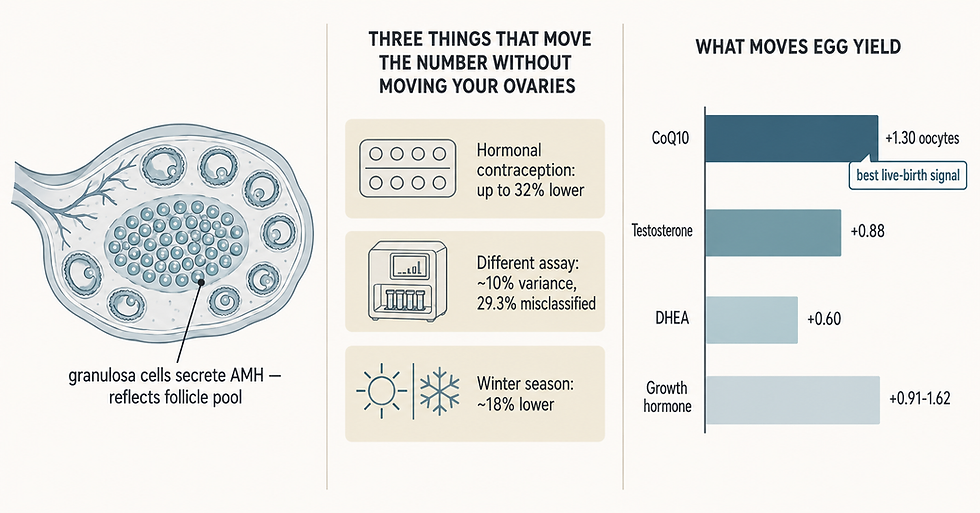
CoQ10 (coenzyme Q10) is a molecule your body produces naturally that fuels the electron transport chain inside mitochondria. Levels decline with age. A 2024 meta-analysis of 6 randomized controlled trials involving 1,529 women with diminished ovarian reserve found that CoQ10 pretreatment significantly improved clinical pregnancy rates (OR 1.84), increased the number of retrieved oocytes, improved embryo quality, and reduced both cycle cancellation and miscarriage rates (Lin et al., Annals of Medicine, 2024). A separate 2025 meta-analysis found CoQ10 increased live birth rates in women with poor ovarian response (OR 2.28) (Schütz et al., Reproductive Biomedicine Online, 2025).
NAC: Protecting Eggs from Oxidative Stress
N-acetylcysteine (NAC) is a precursor to glutathione, your body's most abundant internal antioxidant. A 2022 prospective RCT in 200 women with advanced maternal age found that approximately 45 days of NAC supplementation significantly increased the number of high-quality blastocysts (1.82 vs 1.43, p=0.014) and raised glutathione levels in follicular fluid (Li et al., Frontiers in Medicine, 2022). NAC works by activating the Nrf2 pathway, which governs your cells' antioxidant defense system (Fan et al., Reproduction, Fertility, and Development, 2022).
GPX4 and Ferroptosis: The Newest Finding
This is where the second 2025 study (PMID: 40100097) breaks new ground. Researchers found that a protective enzyme called GPX4 — which prevents a specific type of cell death called ferroptosis — is significantly reduced in the granulosa cells of women with declining ovarian reserve. Granulosa cells are the cells that surround and nourish your developing eggs. When GPX4 drops, those cells die through iron-dependent damage, and egg quality declines with them. When the researchers blocked ferroptosis in aged mice, both oocyte number and quality improved (Hu et al., FASEB Journal, 2025).
While ferroptosis-targeted therapies are still investigational in humans, nutrients that support the GPX4 pathway — particularly selenium, NAC (a glutathione precursor), and vitamin E — are already accessible.
Comparison: Key Supplements and Their Evidence
Supplement | Primary Mechanism | Strongest Evidence | Suggested Dose (from studies) |
CoQ10 (Ubiquinone) | Mitochondrial energy production (ATP) | ↑ pregnancy rates (OR 1.84), ↑ live births (OR 2.28) in poor responders (Lin et al., 2024; Schütz et al., 2025) | 200–600 mg/day for 90+ days |
NAC | Glutathione precursor; Nrf2 antioxidant activation | ↑ high-quality blastocysts in advanced maternal age (Li et al., 2022) | 600 mg/day for 45+ days |
Selenium + Vitamin E | Supports GPX4 enzyme; antioxidant defense | ↑ AMH, ↑ antral follicle count after 90 days (Safiyeh et al., 2021) | 200 mcg Se + 400 IU Vit E for 90 days |
Vitamin D3 | Ovarian function support; hormonal regulation | Associated with improved reproductive outcomes (multiple observational studies) | 2,000 IU/day |
L-Carnitine | Fatty acid transport into mitochondria for energy | Supports mitochondrial metabolism in oocytes (preclinical data) | 300–500 mg/day |
Can You Actually Reverse Egg Quality Decline — or Just Slow It Down?
This is the question no one else fully answers. Here is an honest breakdown.
What you cannot reverse: Once an egg has accumulated chromosomal errors (aneuploidy) during its final division, those errors are permanent. No supplement will turn an aneuploid egg into a euploid one. This is biology, and it applies regardless of age.
What you can influence: The 90-day maturation window before ovulation is where environment matters most. During this period, mitochondrial function, oxidative stress levels, and the health of your granulosa cells directly affect whether a developing egg reaches its full potential or not. The 2025 ferroptosis research (Hu et al., FASEB Journal, 2025) and the CoQ10 meta-analyses (Lin et al., 2024; Shang et al., 2024) both show that intervention during this window can measurably shift outcomes — more retrieved eggs, better embryo grades, higher pregnancy rates.
Think of it this way: you cannot control the hand of cards your ovaries deal each month. But you can make sure the biological environment those cards develop in is as well-supported as possible. A broader 2024 meta-analysis of 20 RCTs in women with ovarian aging found that CoQ10 was more effective than melatonin, myo-inositol, or vitamins alone, with an optimal protocol of supplementation for 3 months before treatment (Shang et al., Advances in Nutrition, 2024).
One formulation worth noting is Rejoova Eggs, developed by three leading fertility specialists, which combines several of the nutrients supported by this research in a single daily protocol: 200 mg CoQ10 (ubiquinone), 600 mg NAC, 300 mg L-Carnitine, Vitamin D3, PQQ for mitochondrial biogenesis, R-Alpha Lipoic Acid, NMN (nicotinamide mononucleotide), and ovary extract. This kind of targeted stack reflects the science: supporting mitochondrial function, glutathione production, and antioxidant defense simultaneously rather than relying on a single ingredient. It pairs with Rejoova Repair — a foundation formula with resveratrol, quercetin phytosome, pine bark extract, and acai to reduce oxidative stress at the cellular level in both men and women. For male partners, Rejoova Sperm applies a parallel approach: CoQ10, NAC, zinc, selenium, and Vitamin D targeted at sperm DNA integrity and motility.
What to Do If You Want to Improve Your Egg Quality After 40
Step 1: Get the right bloodwork. Request these tests from your OB-GYN or reproductive endocrinologist: AMH (anti-Müllerian hormone), Day 3 FSH and estradiol, antral follicle count via ultrasound, ferritin and iron panel, Vitamin D level, and a standard metabolic panel. Ferritin between 60–80 ng/mL and iron between 85–120 mcg/dL are functional ranges that matter for ovarian health — standard lab "normal" ranges are often set too low.
Step 2: Ask your RE these questions. "Based on my AMH and AFC, what is my estimated ovarian reserve?" "Would you recommend a supplement protocol before we start treatment?" "Can we check my follicular fluid antioxidant levels?" "What is your clinic's experience with patients my age using their own eggs?"
Step 3: Set realistic expectations for the first 90 days. Eggs take approximately 90 days to mature from recruitment to ovulation. Any supplement protocol — whether a targeted stack like Rejoova Eggs + Rejoova Repair or individual nutrients — needs at least that window to influence the current crop of developing follicles. You will not see changes on lab work in 2 weeks. Commit to 3 months minimum before assessing results.
Step 4: Address lifestyle factors that compound mitochondrial damage. Eliminate or reduce alcohol (it depletes glutathione), stop smoking and vaping, reduce exposure to BPA and phthalates (switch to glass food storage, non-toxic personal care products), aim for 7–9 hours of sleep (melatonin concentrates in follicular fluid overnight), and follow a Mediterranean-style diet rich in healthy fats, leafy greens, and omega-3 sources.
On cost: A full supplement protocol can range from $80–$200/month depending on whether you buy individual ingredients or a combined formula. Most fertility supplements are not covered by insurance. However, the cost of one additional high-quality embryo in an IVF cycle — or potentially avoiding an extra retrieval cycle — makes a 90-day supplement investment a rational decision for most patients.
Frequently Asked Questions
Is it too late to improve egg quality at 42 or 43?
It is not too late to support the environment where your remaining eggs develop. While the percentage of chromosomally normal eggs decreases with age, the quality of those that remain can still be influenced by mitochondrial support, antioxidant protection, and lifestyle factors during the 90-day maturation window. The CoQ10 meta-analysis showed benefits specifically in women with diminished ovarian reserve (Lin et al., Annals of Medicine, 2024). Your age is one variable — not the only one.
How long do I need to take supplements before they make a difference?
The 90-day egg maturation cycle is your minimum timeline. The largest meta-analysis on CoQ10 found that 3 months of supplementation before controlled ovarian stimulation produced optimal results (Shang et al., Advances in Nutrition, 2024). The NAC study showing improved blastocyst quality used a 45-day protocol (Li et al., Frontiers in Medicine, 2022). Starting sooner is always better than waiting for the "perfect" time.
Does CoQ10 actually help, or is it just marketing?
CoQ10 has the strongest clinical evidence of any fertility supplement studied to date. Across multiple meta-analyses including thousands of women, it has demonstrated improved oocyte retrieval, better embryo quality, higher pregnancy rates, and — in the most recent 2025 meta-analysis — increased live birth rates (Schütz et al., Reproductive Biomedicine Online, 2025). It is not a miracle pill, and it will not override severe age-related decline, but the data supporting it is real and replicated.
What is ferroptosis and should I worry about it?
Ferroptosis is a form of iron-dependent cell death that damages the granulosa cells surrounding your eggs. Research published in 2025 found that a protective enzyme called GPX4 declines in women with reduced ovarian reserve, and that blocking ferroptosis in animal models restored egg quality (Hu et al., FASEB Journal, 2025). You do not need to worry about a specific "ferroptosis supplement" — but ensuring adequate selenium, glutathione precursors (like NAC), and checking your ferritin/iron levels supports the same protective pathway.
Your Eggs Are Not on a Fixed Clock
The science published in 2025 confirms what fertility specialists who work with women over 40 already see: your ovaries respond to how you support them. That does not erase the reality of age. But it does mean that the next 90 days are an opportunity, not a countdown. If you want a personalized plan — bloodwork review, supplement guidance, and a clear-eyed assessment of your options — schedule a consultation with the team at Rejuvenating Fertility Center. You deserve answers, not just statistics.