Global Fertility Decline: Why It’s Not Too Late
"If only we hadn't waited so long." "If only I had frozen my eggs." "I wish I wouldn't have waited."
If you have ever thought or spoken those words, you are not alone. Clinicians at Harvard Health identify these as the most common sentences patients say in fertility clinics. They come from women who built careers, waited for the right partner, and did everything society asked — only to be told their "window has closed." But here is what most of those articles and most of those clinics will not tell you: the window is far wider than conventional medicine suggests, especially when you work with a team that specializes in making it work when others say it cannot.
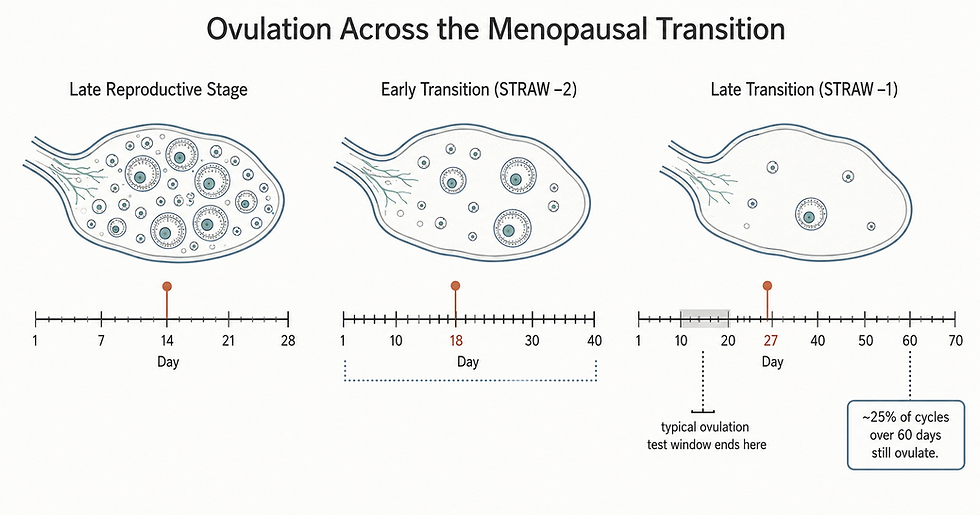
The direct answer: yes, global fertility rates are falling because women are having children later. And yes, egg quality changes with age. But age is a factor, not a verdict. Even women at menopause still have roughly 1,000 dormant eggs inside their ovaries. The real question is not whether your eggs are "too old" — it is whether your medical team knows how to work with what your body still has.
Why Is Fertility Declining Globally? The Real Forces at Work
Nobel laureate Claudia Goldin's 2026 research showed that the worldwide decline in birth rates stems from a mismatch between women's increased agency and persistent traditional gender roles. Countries where women gained education and career access but household labor expectations stayed the same — like Japan, South Korea, Italy, and Spain — saw birth rates plummet below 1.3 per woman.
The IMF reports that deaths now outnumber births in nearly half the world's countries. Brookings research from 2025 points to social comparison between parents and "intensive parenting" norms as additional pressure — parents feel they cannot have children unless every condition is perfect. Meanwhile, housing costs, student debt, and workplace inflexibility keep pushing motherhood later and later.
This is not a personal failure. This is a structural, global pattern affecting virtually every country on earth. And it means that millions of women are arriving at fertility clinics in their late 30s, 40s, and beyond — not because they did anything wrong, but because society made the timing impossible.
What Conventional Data Says — and What It Leaves Out
When most clinics discuss age-related fertility decline, they present national-average IVF statistics. Those numbers are real, and we believe in transparency. Here is what the data shows across all U.S. clinics:
National Average IVF Live Birth Rates by Age
Source: Santoro & Polotsky, New England Journal of Medicine, 2025; ACOG Committee Opinion, 2020
These averages tell you what happens at conventional clinics using conventional protocols. They do not tell you what is possible with specialized, individualized care — which is exactly the distinction that matters when you are over 40.
Consider: Rejuvenating Fertility Center (RFC) reports a 59% IVF success rate that surpasses the national average of 43%, with a 68% success rate for IVF with PGT-A. RFC has helped the highest number of women in their late 40s and early 50s achieve pregnancy using their own eggs — including the oldest woman in the United States to get pregnant by IVF with her own eggs, at age 51.
National averages are not your personal prognosis.
The Question Nobody Else Answers: What If You Were Told There Is Nothing Left?
This is the gap in every article about why fertility is declining. They present the statistics, tell you the clock is ticking, and leave you feeling like your biology is a sentence. They never ask: what if the approach — not your body — is the problem?
Here is the medical fact most patients are not told: even women who have reached menopause, with an AMH (anti-Müllerian hormone) reading of zero, still have approximately 1,000 dormant eggs inside their ovaries. These eggs are not gone. They are asleep. The challenge is waking them up and supporting their quality — and that is precisely what ovarian rejuvenation is designed to do.
PRP (Platelet-Rich Plasma) ovarian rejuvenation uses your own blood's growth factors, injected directly into the ovaries, to stimulate dormant follicles. For women with extremely diminished reserve or who are over 45, Adipose-PRP ovarian rejuvenation combines fat-derived stem cells with PRP for enhanced regenerative potential. RFC was the first clinic in the world to publish live births in women over 45 using this approach (Merhi et al., multiple peer-reviewed publications).
This does not mean success is guaranteed for every patient. Ovarian rejuvenation is still an emerging treatment, and outcomes vary. But it means that a diagnosis of diminished ovarian reserve — or even an AMH of zero — is not the end of the conversation. It is the beginning of a different one.
What to Do Right Now — Whether You Are 32 or 47
Whatever age you are reading this, there are concrete steps you can take today.
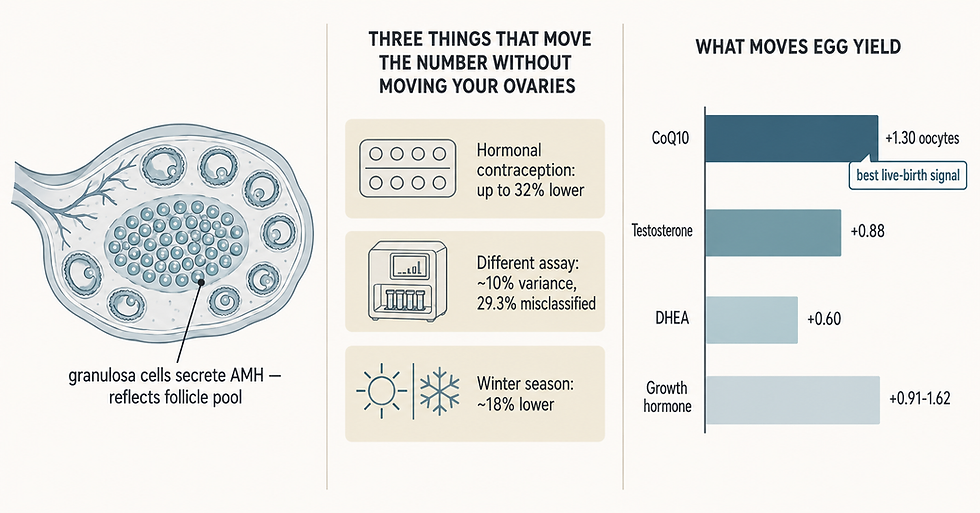
Step 1: Get baseline testing. Request an AMH blood test and a transvaginal ultrasound for an antral follicle count. These two tests together give the clearest snapshot of your ovarian reserve. Your OB-GYN can order them, or you can go directly to a reproductive endocrinologist.
Step 2: Know the evaluation timeline. ACOG (2025) recommends fertility evaluation after 12 months of trying for women 35 and under, after 6 months for ages 36 to 40, and immediately for women over 40. If you are over 40, do not wait — time matters, and a specialized clinic can often move fast.
Step 3: Ask the right questions at your consultation.
"Do you have experience treating women my age with their own eggs?"
"What protocols do you use differently for women with low AMH or diminished reserve?"
"Do you offer Mini-IVF or Natural IVF?"
"Do you offer any regenerative treatments like PRP ovarian rejuvenation?"
Step 4: Understand cost realities. The average IVF cycle in the U.S. runs $12,000 to $17,000 not including medication. RFC offers transparent pricing significantly below most NYC clinics — egg retrieval at $1,250, egg freezing at $1,250, IUI at $750, PRP ovarian rejuvenation at $2,250. New York State mandates IVF coverage for many insurance plans, so check your benefits first.
Step 5: If another clinic told you to give up — get a second opinion. RFC treats patients that other clinics have turned away. Over 50% of RFC's patients come from outside the New York area through their outside monitoring program, which means you can do all your bloodwork and ultrasounds locally and travel to RFC only once for the procedure itself.

Frequently Asked Questions
Is the global fertility decline a medical problem or a social choice?
Both. Research from Claudia Goldin (NBER, 2025) and ASRM (2025) confirms that delayed marriage, economic pressure, and intensive parenting norms drive birth rates down. But biology also plays a role — egg quality changes with age, and environmental factors may affect fecundity at a population level (Aitken & Norman, Fertility and Sterility, 2025). The important thing to understand is that societal-level trends do not determine individual outcomes.
Can I still get pregnant with my own eggs after 40?
Yes. While national average IVF success rates do decline with age, those averages reflect what conventional clinics achieve with standard protocols. Clinics that specialize in treating women over 40 — using individualized protocols, Mini-IVF or Gentle-IVF, and regenerative options like Adipose-PRP ovarian rejuvenation — achieve results that far exceed the national averages. RFC has helped women in their late 40s and early 50s have babies with their own eggs.
What is ovarian rejuvenation, and does it really work?
Ovarian rejuvenation uses your own body's growth factors (PRP) or stem cells (Adipose-PRP) injected into the ovaries to support dormant follicle reactivation. It is still considered emerging, and results vary by patient. That said, there are now over 160 peer-reviewed publications supporting its potential, and RFC has published world-first live births in women over 45 using Adipose-PRP. It is not a guarantee, but for women with low or zero AMH, it opens a door that conventional treatment does not.
My AMH is very low or even zero. Does that mean I have no eggs left?
No. An AMH of zero means your measurable ovarian reserve is extremely low — it does not mean your ovaries are empty. Women at menopause still have approximately 1,000 dormant eggs that standard tests cannot detect. The challenge is that conventional IVF protocols were not designed to work with these dormant follicles. Ovarian rejuvenation at RFC is specifically designed to support reactivation of these dormant eggs, giving patients with diminished reserve a path that most other clinics do not offer.
The global fertility decline is real. The societal pressures that pushed millions of women to delay motherhood are real. But the idea that age alone determines whether you can become a mother — that is not the full story. Your body still holds more potential than most clinics are equipped to unlock.
If you want to find out what is actually possible for you, Rejuvenating Fertility Center offers consultations for patients at any age, any AMH level, anywhere in the world. No age cutoffs. No weight cutoffs. Just an honest assessment and a plan built around what your body can still do.